Product Details
120 GHz WIDE BAND TRANSCEIVER – TRA_120_045
120-GHz Wide-Band IQ Transceiver with Antennas on Chip
TRA_120_045 operates from 113.9 GHz to 134.1 GHz and thus has a very high band width. This enables measurements with a resolution of less than 1 mm. Despite these outstanding values of the MMIC, it is only 5 x 5 mm² in size and comes in a standard QFN32 package. The antennas for the RX and TX channel are designed as dipoles directly on the chip. The highly integrated construction results in the small form factor and particularly low losses on the signal path.
The radar frontend TRAˍ120ˍ045 is an integrated wideband transceiver circuit with antennas on chip. It provides a frequency bandwidth of greater than 20GHz. The circuit includes a low-noise amplifier (LNA), quadrature mixers, a poly-phase filter, a voltage-controlled oscillator, divide-by-64 outputs, and transmit and receive antennas .The RF signal from the oscillator is directed to the RX path via buffer circuits and polyphase filter to provide quadrature LO signal to the two RX mixers. The RX signal coming from RX antenna is amplified by LNA and converted to baseband by two mixers with quadrature LO signal. The integrated VCO has two analog tuning inputs. These two tuning inputs can be used to obtain the full tuning range of greater than 20GHz.
The on-chip VCO together with integrated frequency divider and external fractional-N PLL can be used for frequency modulated continuous wave (FMCW) radar operation. With a fixed oscillator frequency, it can be used in continuous wave (CW) mode. Other modulation schemes such as FSK can be implemented by utilizing the analog tuning inputs. The IC is fabricated in a BiCMOS technology.
Features of 120 GHz WIDE BAND TRANSCEIVER – TRA_120_045
- Wide-band radar frontend (RFE) with antennas on chip
- Frequency bandwidth of 20GHz
- Frequency range from 114GHz to 134GHz
- Single supply voltage of 3.3V
- Fully ESD protected device
- Power consumption of 550mW
- Integrated low phase noise VCO
- Receiver with homodyne quadrature mixer
- RX and TX dipole antennas
- QFN32 leadless plastic package 5 × 5mm²
- Pb-free, RoHS compliant package
- IC is available as bare die as well
Applications Of 120 GHz WIDE BAND TRANSCEIVER – TRA_120_045
The main application field of the wideband transceiver radar frontend (RFE) without beam focusing element is in short range (in the order of about 5 meters) and high-resolution radar systems. By using dielectric lenses, the range can be increased from a multiple of 10 meters to up to 100 meters. Depending on the measurement target specification a trade-off between measurement resolution and range is required.
The RFE can be used in FMCW mode as well as in CW mode. The transceivers are designed for maximum bandwidth by using two tuning inputs with different tuning ranges and tuning slopes. This makes it possible to extend the bandwidth to the entire tuning range mentioned above.
- ARTICLE NUMBER: TRA_120_045
- FREQUENCY: 120 GHz
- FREQUENCY RANGE MIN/MAX: 113.9 GHz / 134.1 GHz
- OPERATION MODE: FMCW / CW
- SINGLE SUPPLY VOLTAGE: 3.3 V
- CURRENT CONSUMPTION: 166 mA
- PACKAGE QFN 32: 5 x 5 mm²
- EVALUATION BOARDS / KITS: EVALKIT SiRad Easy® r4
Supplier Details
Mr. Hiren Ajmera
710, Dev Plaza, 7th Floor, Opp.Fire Station, Andheri (West), Mumbai – 400058, Mumbai, Maharashtra Pincode : 400058
27AABCB6550A1Z5
Verified Supplier
More Product For This Supplier
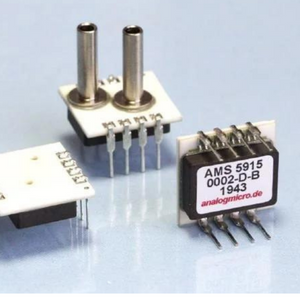
AMS 5915 Board-Mount Pressure Sensor with I2C Output
SENSORS
Pressure Sensors
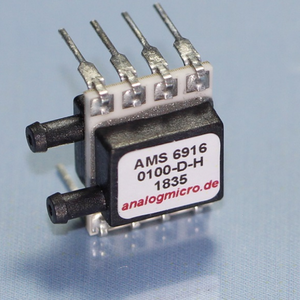
AMS 6916 Board mount pressure sensor
SENSORS
Pressure Sensors
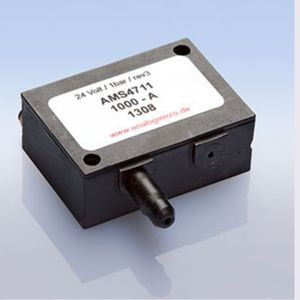
AMS 4711 Miniaturized pressure transmitter
SENSORS
Pressure Sensors
AM422-1 Voltage to Current Converter IC
SENSORS
Pressure Sensors

CAV444 Converter IC for capacitive signals
SEMICONDUCTOR
Integrated Circuits - ICs

120 GHz RADAR TRANSCEIVER – TRA_120_002
SEMICONDUCTOR
Integrated Circuits - ICs